
June 2026

Spirit of the Eagle
St. John the Evangelist ACC
Spiritual Tidbits & Rector’s Reflections for
June 2026 from Father Tim
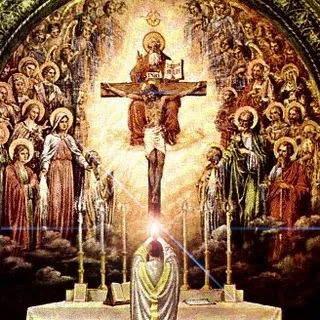
Summer 2026 is finally here after quite a rainy Spring, and our long Trinity Season has arrived. June contains four Trinitytide Sundays (7th, 14th, 21st, & 28th). Other holy days to note are Corpus Christi (4th), S. Barnabas, Apostle & Martyr (11th), Sacred Heart of Jesus (12th), Nativity of S. John Baptist (24th), S. Peter, Apostle & Martyr (29th), and S. Paul, Apostle & Martyr (30th). This month I would like to share a little information on Corpus Christi, also called Eucharist Thursday. Corpus Christi is the first Thursday after Trinity Sunday. It is officially named the ‘Solemnity of the Most Holy Body and Blood of Christ’ and is thus a Feast and Solemnity, and was set apart by the Western Church in the 13th century in honour of the Mystery of our Lord’s Presence in the Blessed Sacrament. Why? Because it was felt that this sacred Mystery could not be adequately commemorated on the day of its institution, which occurs in the midst of the mournful celebration of His Passion. On that dark night ‘in which He was betrayed’, Judas Iscariot, the traitor, left the lighted Upper Room. During that dark moment a fire was lit which has been burning ever since. It was on that night that Jesus Christ pledged Himself to us for ever. St. John of the Cross would write, The eternal Fount is hidden in Living Bread, That we with Life eternal may be fed, Although ‘tis night. From that Upper Room there stretches an unbroken chain of light – links of fire burning in the darkness down through the centuries to our present day. The Eucharist is the central act of our Christian worship. It gathers up, expresses, and makes effective the whole meaning of a spiritual life as it proclaims the Gospel. The meaning of the Eucharist is inexhaustible, and transcends all our efforts to explain or interpret it. We never come to the end of it, and long experience only deepens our wonder and our awe. No one name for the rite ever expresses the whole: ‘Holy Communion’ denotes one element, but excludes others. The ‘Lord’s Supper’ expresses the historic basis and the fellowship of the Sacrament. The words ‘Eucharist’ and ‘Oblation’, which come from the very early Church, stress the essential elements of ‘worship’ and ‘offering’. ‘The Holy Sacrifice’, a title used by some of the early Church Fathers, emphasizes the sacrificial aspect. It is only when all of these different aspects are seen to be part of a single act of worship that something of the wonder of the Eucharist begins to dawn upon us. This is why we celebrate Corpus Christi. ~ Father Tim
✠✠✠
Do you know any souls lost in the dark? Someone who needs the Light of Christ? If yes, please invite them to church this June, where they can experience the wonder and awe of the Living Bread. ~ Father Tim
✠✠✠
Nowhere is God so near to man as in Jesus Christ; and nowhere is Christ so familiarly represented to us, as in this Holy Sacrament. ~ Richard Baxter, 1615-1691, English Church Leader, Theologian, Controversialist, & Poet
✠✠✠
Did you know?
Did you know St. John’s gave a charitable donation to the ACC Saint Paul Mission Fund in May? Did you know Saint John’s has begun the process of being listed on the National Register of Historic Places? Did you know our June Book of Life Club will be discussing The Cost of Discipleship, by Dietrich Bonhoeffer?
✠✠✠
Saint John June Ordo Kalendar
Wednesday, the 3rd of June, at 6:30 PM, Evening Prayer
Sun., the 7th of June, at 10:30 AM, Trinity I Mass
Wed., the 10th of June, at 6:30 PM, Evening Prayer
Sunday, the 14th of June, at 9:00 AM, Morning Prayer
Sun., the 14th of June, at 9:45 AM, Psalm-Children Sun. School Class
Sun., the 14th of June, at 10:30 AM, Trinity II Mass
Wednesday, the 17th of June, at 6:30 PM, Evening Prayer
Saturday, the 20th of June, at 9:00 AM, Morning Prayer
Saturday, the 20th of June, at 9:45 AM, Bible Study
Sat., the 20th of June, at 11:00 AM, Book of Life Club, The Cost of Discipleship
Sun., the 21st of June, at 10:30 AM, Trinity III Mass
Wed., the 24th of June, at 6:30 PM, Evening Prayer, Nativity of S. John Baptist
Sun., the 28th of June, at 9:45 AM, Psalm-Children Sun. School Class
Sun., the 28th of June, at 10:30 AM, Trinity IV Mass, Vestry Mtg
✠✠✠
We call this food the thanksgiving [Eucharist], and the only people allowed to receive it are those who believe our teaching and have received the washing for the remission of sins and for regeneration; and who live according to the commands of Christ. ~ Justin Martyr, 90-165 AD, Theologian, Apologist, and Martyr
✠✠✠

June Birthdays & Anniversaries
Janet Hoyle – Birthday – June 1
Bill & Gayle Hill – Anniversary – June 4
Judy Denton – Birthday – June 8
Rick Hanson – Birthday – June 9
Janet & Fr. Tim Butler – Anniversary – June 30
✠✠✠
Why should we want to worship Jesus well?
The benefits [the Lord’s Supper] confers are spiritual, not physical. Its effects must be looked for in our inward man. It was intended to remind us, by the visible, tangible emblems of bread and wine, that the offering of Christ’s body and blood for us on the cross, is the only atonement for sin, and the life of a believer’s soul. It was meant to help our poor weak faith to closer fellowship with our crucified Savior, and to assist us in spiritually feeding on Christ’s body and blood. It is an ordinance for redeemed sinners, and not for unfallen angels. By receiving it we publicly declare our sense of guilt, and need of a Savior – our trust in Jesus, and our love to Him – our desire to live upon Him, and our hope to live with Him. Using it in this spirit, we shall find our repentance deepened, our faith increased, our hope brightened, and our love enlarged – our besetting sins weakened, and our graces strengthened. It will draw us nearer to Christ. ~ J.C. Ryle, 1816-1900, Anglican Bishop of Liverpool & Author
✠✠✠
We do not sin when we adore Christ in the Eucharist; we do sin when we do not adore Christ in the Eucharist. ~ S. Augustine, 354-430 AD, Bishop, Church Father, Doctor of the Church
✠✠✠
The brothers and sisters who would like to work for the conversion of souls, should try to participate every day in the sacrifice of the Mass. Let them remember that Mass is both Christmas and Calvary. A single Mass gives more glory to God than the martyrdom of the whole of humanity, united with the praises of all the angels and the saints. Where you have the Blessed Sacrament, there you have the living God, the Saviour, as really as when he was living in Galilee and Judea, as really as when he is now in heaven. Never lose a Communion by your own fault. Communion is more than life, more than all the goods of this world, more than the entire universe. It is God Himself, it is Jesus. Can you prefer anything else? If you love Jesus sincerely, can you willfully lose the grace of his coming within you? Jesus asks you to love him with all the energy and the simplicity of your heart. ~ S. Charles de Foucauld, 1858-1916, Apostle of the Sahara
✠✠✠
I get asked sometimes about other religions, as in, religious experiences that people have. Aren’t they valid? The Mormon will tell me about how they felt the “burning in the bosom” as they read the Book of Mormon, which testified to them that the Latter-Day Saints are the true Christian church. The pagan may experience a profound sense of calm while out in the wilderness, or even an encounter with a spiritual entity. The Wiccan may genuinely commune with a spirit, or may actually work magic. The Buddhist might claim to experience an entire emptying of themselves and the loss of all desire (a taste of nirvana). Muhammad may genuinely have encountered a spiritual being that dictated the Qur’an to him. The challenge to Christians is “You have your experience of the divine, something that you are absolutely persuaded is not of this world, and I have mine. Can’t we just each do our thing?” Can? Yes. Should we? Not so fast.
There’s a few possible strategies to respond with. One option is to challenge the experience, and deny that it in fact happened. Perhaps the person talking to you is lying, although in general I don’t recommend leading with accusing someone of this. But maybe the person really is convinced, and someone else is lying to them. This is possible in the case of Islam, whose historical claims about its beginnings are shaky. A new booklet released by Ratio Christi that I can leave with the others in the narthex (Creating Islam) challenges the existence of the historical Muhammad and the typical narrative about how Islam began. It also has some good tips on how you can engage Muslims. You can read and decide for yourself what you think of this strategy.
Another option is to say that the person has misattributed the cause of the experience. They really did have a transcendent experience; but perhaps it was due to social pressure or manipulation. I suspect this is the case with Mormonism and other cults, who operate by emotional manipulation and “love bombing”. Cults want you to not think critically; I have heard Mormon missionaries state “Logic is a tool of Satan.” Or perhaps drug use was involved, and led someone to experience a feeling of bliss, and any messages “received” are a product of the person’s subconscious. Jeremiah 17:9 says the heart is deceitful above all things, and I think we underestimate the power that wishful thinking can have on our beliefs.
This is long enough now, and so I’ll throw out some other strategies to consider in next month’s Spirit of the Eagle. ~ Chris Stockman
✠✠✠
O Lord, we cannot go to the pool of Siloe to which you sent the blind man. But we have the chalice of Your Precious Blood, filled with life and light. The purer we are, the more we receive. ~ S. Ephrem the Syrian, 306-373 AD, Harp of the Spirit, Deacon, Confessor and Doctor of the Church, Venerable Father, Hymn Writer, Teacher of the Faith
✠✠✠
How many of you say: I should like to see His face, His garments, His shoes. You do see Him, you touch Him, you eat Him. He gives Himself to you, not only that you may see Him, but also to be your food and nourishment. ~ S. John Chrysostom, 347-407 AD, Bishop & Doctor of the Church
✠✠✠
✠✠✠
He is The Bread sown in the virgin, leavened in the Flesh, molded in His Passion, baked in the furnace of the Sepulchre, placed in the Churches, and set upon the Altars, which daily supplies Heavenly Food to the faithful. ~ S. Peter Chrysologus, 380-450 AD, Bishop, Confessor, and Doctor of the Church
✠✠✠
The seeking of Jesus Christ and the quest for chivalry combined lead directly to one place only: Anglican-Catholicism. Courage, honor, courtesy, justice, and a readiness to help and defend the weak and the poor. Welcome to the Anglican Catholic Church. ~ Father Timothy Butler