
July 2025


Spirit of the Eagle
St. John the Evangelist ACC
Spiritual Tidbits & Rector’s Reflections for
July 2025 from Father Tim
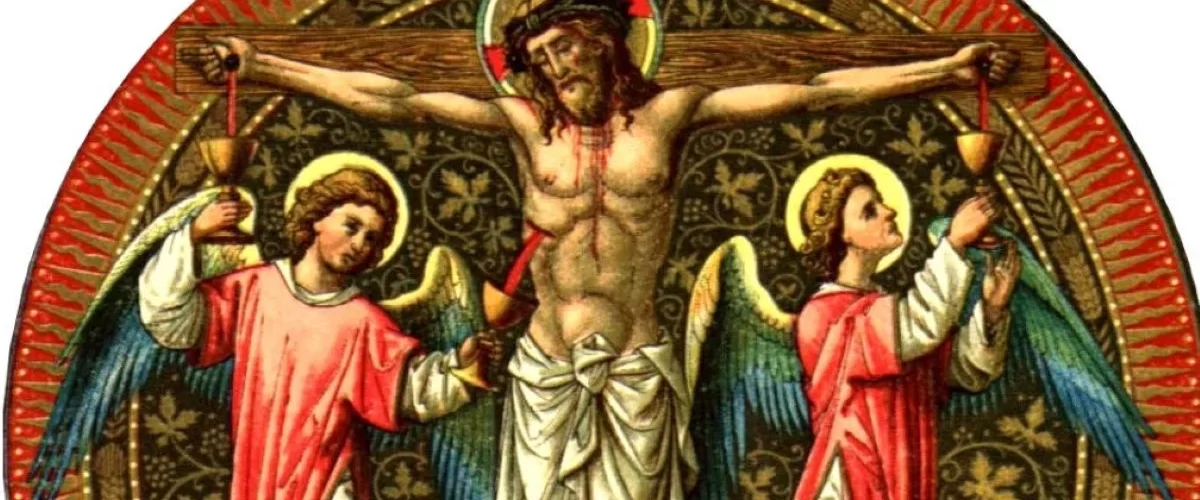
July 2025 has arrived with something like a heated vengeance. It has been hot! Along with the four Trinity Sundays (6th, 13th, 20th, & 27th) the month of July arrives with the Precious Blood (1st), and S. James Apostle & Martyr (25th). Each Holy Mass we gather together to receive the Precious Blood. This choice of words can be somewhat unsettling for an unbeliever who knows very little about Christianity. We should know how to explain such a staggering declaration. To drink the Blood of Jesus means to receive His living power, the power of our risen Lord, the Captain of our Salvation, victor over sin and death. For in the Old Testament idea of sacrifice ‘the blood is the life’, and when blood is shed the life is poured forth. So in each Communion we receive Christ in all His living power. Through this Sacramental Communion Jesus wills to dwell with us forever. We are therefore to ‘feed on Him in our hearts’, and to continually abide in Christ. We know that we are utterly dependent on Christ. We cannot serve, pray, suffer, or give ourselves, unless He communicates His power to us, filling us with His Spirit of love and readiness for sacrifice. In the intimacy of Communion He gives us new energy, new power to endure, to suffer, to love, to give all to the uttermost and very end. During past ages of persecution the Eucharist, and readiness to ‘drink the Cup’ of Christ, were always closely associated. St. Cyprian, who died a martyr’s death in 258, wrote the following to his flock when he foresaw trouble: We ought not to think that everything will go on as it has done hitherto; rather there awaits us a far harder and more terrible conflict, for which Christ’s soldiers must prepare themselves with unshakable faith, and with much energy; they should therefore consider that for this reason they ought to drink the Cup of Christ daily, in order that they may be enabled to shed their blood for Christ. Challenges come to us daily in every generation. One 17th century author wrote, He who often receives Christ in the Holy Communion and still shirks suffering, certainly does not communicate as he ought, because he does not receive the highest effects of the divine union, which is that we should be filled with the love which animated Jesus on earth. Prayer and frequent Communion give people ‘the courage of a lion’, and enables them to act, to serve, and to suffer. In a past missionary exhibition, there stood alone, a small battered chalice. Out of this cup scores of Malagasy Christians had received Communion before being hurled over a cliff to their death in the 19th century, during a time of fierce persecution. ~ Father Tim
✠✠✠
Do you know someone who needs the strength for sacrifice? If yes, please invite them to church this July, where they can find the Precious Blood, and ‘drink the Cup of Christ’. ~ Father Tim
✠✠✠
We must not make great knowledge, and great strength of grace, an indispensable qualification for communicants. A man may know but little, and be no better than a child in spiritual strength, but he is not on that account to be excluded from the Lord’s table. Does he really feel his sins? Does he really love Christ? Does he really desire to serve Him? If this be so, we ought to encourage and receive him. Doubtless we must do all we can to exclude unworthy communicants. No graceless person ought to come to the Lord’s Supper. But we must take heed that we do not reject those whom Christ has not rejected. There is no wisdom in being more strict than our Lord and His apostles. ~ J.C. Ryle, 1816-1900, Anglican Bishop of Liverpool
✠✠✠
Do you know?
Do you know Saint John’s gave a charitable gift to Holly Hill Child & Family Solutions in June? Do you know our Book of Life Club will begin our discussion of Orthodoxy by G.K. Chesterton in July? Do you know our Confirmation Classes will conclude in July and the Bible Study will resume each month? Do you know Bishop Fodor will make his Episcopal visit in August? Do you know we are planning a trip to a Reds game in September as a church group?
✠✠✠
Saint John July Ordo Kalendar
Wednesday, the 2nd of July, at 6:30 PM, Evening Prayer
Sunday, the 6th of July, at 10:30 AM, Trinity III, Morning Prayer
Wednesday, the 9th of July, at 6:30 PM, Evening Prayer
Sunday, the 13th of July, at 10:30 AM, Trinity IV Mass
Wednesday, the 16th of July, at 6:30 PM, Evening Prayer
Saturday, the 19th of July, at 9:00 AM, Morning Prayer
Sat., the 19th of July, at 9:45 AM, Book of Life Club, Orthodoxy
Sunday, the 20th of July, at 10:30 AM, Trinity V Mass
Wednesday, the 23rd of July, at 6:30 PM, Evening Prayer
Saturday, the 26th of July, at 8:00 AM, Rule of Faith Meeting
Sunday, the 27th of July, at 10:30 AM, Trinity VI Mass
Wednesday, the 30th of July, at 6:30 PM, Evening Prayer
The final Confirmation Class will take place in August
✠✠✠
When we work hard, we must eat well. What a joy that you can receive Holy Communion often! It’s our life and support in this life – Receive Communion often, and Jesus will change you into Himself. ~ Unknown Author
✠✠✠

July Birthdays & Anniversaries
Kyle & Alyssa Maycock – Anniversary – July 8
Leslie Shelton & Michael Griswold – Anniversary – July 9
Emily Dunn – Birthday – July 15
John & Janet Hoyle – (60th!)Anniversary – July 20
Judie Boughner – Birthday – July 21
✠✠✠
Why should we want to worship Jesus well?
Again, giving directions to his disciples to offer to God the first-fruits of his own, created things–not as if He stood in need of them, but that they might be themselves neither unfruitful nor ungrateful–he took that created thing, bread, and gave thanks, and said, ‘This is my body’ [Matt. 26:26]. And the cup likewise, which is part of that creation to which we belong, He confessed to be His blood, and taught the new oblation of the new covenant; which the Church, receiving from the apostles, offers to God throughout all the world to Him who gives us as the means of subsistence the first-fruits of his own gifts in the New Testament, concerning which Malachi, among the twelve prophets, thus spoke beforehand: “I have no pleasure in you, saith the Lord Almighty, and I will not accept sacrifice at your hands. For from the rising of the sun to its going down, my name is glorified among the Gentiles, and in every place incense is offered to my name, and a pure sacrifice; for great is my name among the Gentiles, saith the Lord Almighty”; [Mal. 1:10-11–indicating in the plainest manner, by these words, that the former people [the Jews] shall indeed cease to make offerings to God, but that in every place sacrifice shall be offered to him, and that a pure one; and his name is glorified among the Gentiles. (Against Heresies, Bk. IV, ch. 17, par. 5) ~ S. Irenaeus, 125-202 A.D., Bishop & Doctor of the Church
✠✠✠
In the Mass the blood of Christ flows anew for sinners. ~ S. Augustine, 354-430, Bishop of Hippo Regius, Church Father, & Doctor of the Church
✠✠✠
The Council of Nicaea 325 A.D.
Trinity is underway, and this particular Trinitytide is noteworthy, as 2025 is the 1700th anniversary of the famed first ecumenical council, the Council of Nicaea in 325. It met during the summer months of 325, adjourning in either July or August, and so I think now is an apt time for some apologetics-oriented reflections on it. For any church practice or belief that seems nonsensical or objectionable to someone, it is common to lay it at the feet of Nicaea and the imperial interference of the pagan emperor Constantine the Great. Now, I personally do not see reason to think that Constantine was a pagan bent on corrupting Christianity, and claims of “imperial interference” are massively overblown, but those are side issues.
Much more important is talk of the canon of Scripture, the deity of Jesus, and the Trinity being Nicene novelties. These claims are not common in the scholarly guild on the topic, but they are on the street. Several years ago I was buying a book about early Christianity (“From Jesus to Christianity” by L. Michael White, if you wanted a book to happily not read) at Barnes and Noble, and the cashier was under the impression that the New Testament came out of Nicaea! I talk with Muslim students sometimes who claim that Jesus was not originally held to be divine, but that this declaration was also from Nicaea 300 years after the fact. Jehovah’s Witnesses, and some falsely so-called “biblical” Unitarians, will also claim this. Essentially, anyone who claims to be a radical reformation to true, original Christianity (as with Unitarians), or a restorationist cult (as with Jehovah’s Witnesses and Mormons), or a heretical sect that took on a life of its own (as with Muslims) tries to pass their view off as the oldest one to legitimize it. That strategy has been employed many times by Christians in various intramural debates, so I’m in favor of this move, but it is only as good as the evidence in the sources that have come down to us. And the evidence is quite one-sided here.
The “canon of Scripture invention” is the easiest of the myths to dispel, and so I won’t say anything here beyond that one can read the canons of Nicaea and see very quickly that what was in and what was out was not discussed there. A bit more complicated are the topics of the deity of Jesus and the Trinity. Claims of these being invented at Nicaea are still false, but more needs to be said. The truth of the matter of what the actual debates were at Nicaea is incredibly complicated, and there are good reasons why scholars write monographs that only five people read about it. It’s not that they necessarily have good reasons for writing them, but that there are good reasons why only five people read them. So, I won’t bore you with the ins and outs of them here, but I will say a little about the actual history of these beliefs. (And besides, the Trinity and deity of Jesus are taught in Scripture, which I am assuming you know where, in focusing on the historical questions here.) Church fathers such as Origen (AD 185-253, in “On First Principles”) and Ignatius of Antioch (d. likely AD 107-117), in his epistle to the Ephesians, refer to Jesus as “God”. Origen was controversial in his own lifetime and for centuries afterwards, partially because he threw a bone to both heretics and Catholics alike, but where he was right, he was right. 2 Clement, a homily from the 2nd century, begins with “Brethren, it is fitting that you should think of Jesus Christ as of God — as the Judge of the living and the dead. And it does not become us to think lightly of our salvation; for if we think little of Him, we shall also hope but to obtain little [from Him].” Melito of Sardis (~AD 100-180) says in his ‘On Pascha’ that Jesus “rose from the dead as God, being God by his nature and a man.” We have similar attestation to the Trinity, with the word “Trinitas” seeming to first appear with the writings of Tertullian (AD 160-240), who was concerned to uphold the distinction between the persons in the face of heretics that collapsed them. Dionysius of Alexandria (d. AD 265), in a letter to the bishop of Rome, was concerned to avoid separating the persons from one another, and thus affirming multiple Gods. These and many other sources show the Church had been concerned to carry out a balancing act on the Trinity since long before Nicaea.
The beginning of 2 Clement above sets the stakes for why this even matters: our salvation. Are we being taken up into God, or a creature? Who is saving us–the Creator of all, taking back what is His, or a lesser creator stepping into what is not His place? That, to my mind, was the most disturbing implication of “Arianism”: that God is inaccessible to and unknowable by us. Hence the need for the creation of the knowable Son in Arius’ theology. (Why the “”s are there is another long, complicated story.) So, with this embarrassment of riches, how can anyone make such plainly erroneous claims? For some, it’s that they don’t know any better. Others do, and disregard them not out of malice, but rather because they raise the bar of what counts as belief in a divine Jesus or a Trinity to an absurd degree. For some, nothing short of the conclusions of later ecumenical councils such as Constantinople I in AD 381, which had the advantage of years of philosophical reflection on different concepts, counts as “the doctrine of the Trinity”. This is as silly as suggesting that Isaac Newton, in the early 18th century, had no belief in a theory of gravity because he lacked the more mathematically developed, and experimentally verified, theory of Albert Einstein in the early 20th century. There is far, far more to be said on these points than is feasible to bring out in this one already-long-enough piece, but hopefully this has been helpful or interesting to someone. And if you liked this, consider participating in our Rule of Faith discussions, as these are the sorts of issues that we get into. ~ Chris Stockman
✠✠✠
And that the blood is the Word, is testified by the blood of Abel, the righteous interceding with God. For the blood would never have uttered a voice, had it not been regarded as the Word: for the righteous man of old is the type of the new righteous one; and the blood of old that interceded, intercedes in the place of the new blood. And the blood that is the Word cries to God, since it intimated that the Word was to suffer. (The Instructor I:6) ~ S. Clement of Alexandria, 150-215 A.D., Church Father & Theologian
✠✠✠
Receive Communion often, very often…there you have the sole remedy, if you want to be cured. Jesus has not put this attraction in your heart for nothing. ~ S. Therese of Lisieux, 1873-1897, Virgin & Doctor of the Church
✠✠✠

O Lord, we cannot go to the pool of Siloam to which you sent the blind man. But we have the chalice of Your Precious Blood, filled with life and light. The purer we are, the more we receive. ~ S. Ephrem the Syrian, 306-373, Harp of the Spirit, Deacon, Confessor and Doctor of the Church; Venerable Father, Hymn Writer, & Teacher of the Faith
✠✠✠
The seeking of Jesus Christ and the quest for chivalry combined lead directly to one place only: Anglican-Catholicism. Courage, honor, courtesy, justice, and a readiness to help and defend the weak and the poor. Welcome to the Anglican Catholic Church. ~ Father Timothy Butler